You have a finished manuscript, a designer on standby and one decision that will shape both your budget and your launch date: offset or digital? The honest answer is that neither method is better in the abstract. What matters is your quantity, your deadline, the paper you want under your fingers, and how much of your money you are willing to lock up in boxes. Here is how to weigh the two up without guesswork.
What actually happens in each process
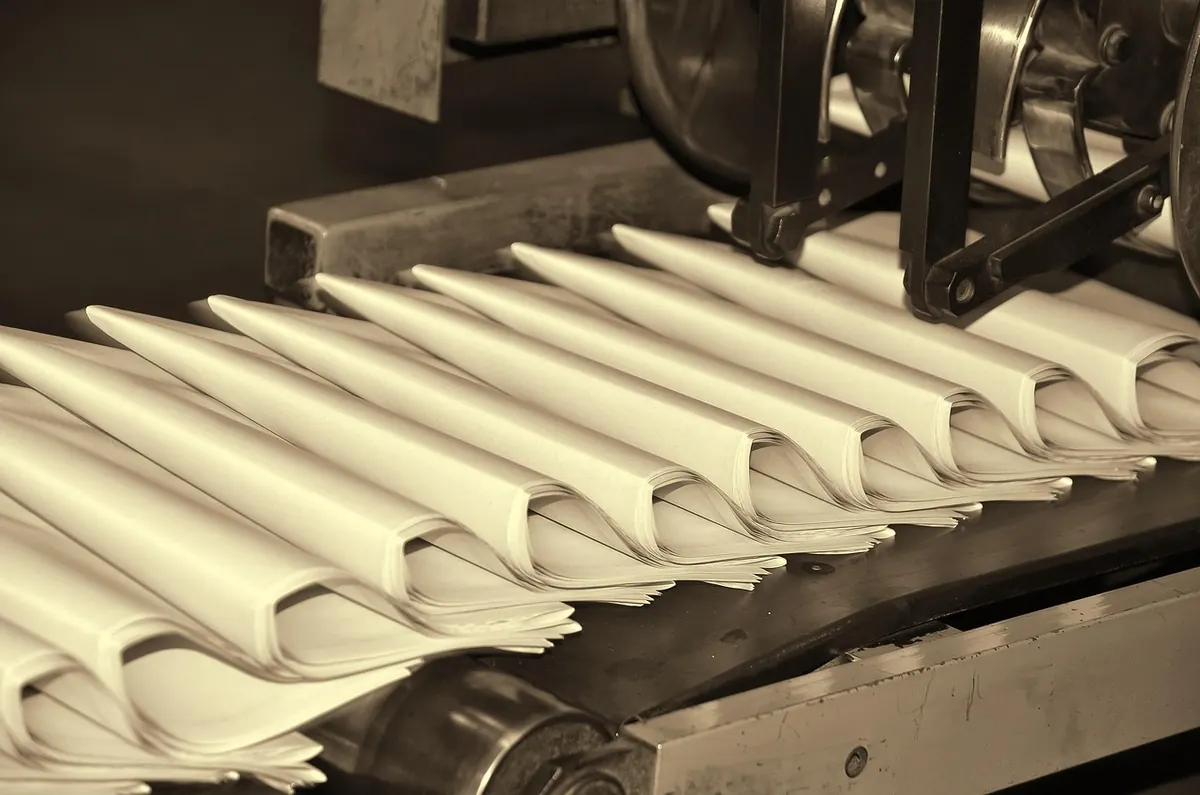
Offset printing, often called litho, uses metal plates. Your file is burned onto a plate for each colour, the plates are mounted on rollers, and ink is transferred onto paper through a series of cylinders. Setting up those plates takes time, labour and materials — which is why the setup bill is substantial and the unit price is low. Once the press is running, printing the two-thousandth copy costs barely more than printing the two-hundredth.
Digital printing skips the plates entirely. Your PDF goes straight to a toner or inkjet press, which prints each copy individually from the file. Setup is minimal, so a short run is affordable. The trade-off is that every copy carries roughly the same production cost, so the unit price barely drops as the quantity rises.
Cost: setup charges versus unit price
Think of offset as high fixed costs and low variable costs; digital as low fixed costs and higher variable costs. Whether that favours you depends entirely on how many copies you actually need.
The crossover point
Somewhere in the middle, the two lines meet. Below that point, digital is cheaper. Above it, offset wins — often by a wide margin. Where that point sits varies with page count, trim size, paper, colour and the individual printer's pricing, so treat any rule of thumb with suspicion. For a standard black-and-white paperback of a few hundred pages, it is commonly somewhere between a few hundred and a couple of thousand copies, but your own quotes are the only reliable guide.
Ask two or three UK printers for quotes at several quantities — 250, 500, 1,000, 2,000 and 5,000 — and compare the totals rather than the per-copy figures. A single quote at one quantity tells you very little.
Then add the costs that never appear on the quote: storage, insurance, and the cash tied up in pallets of stock that may take years to sell. A cheaper per-unit price is only a bargain if you can move the units.
Quantity: what your run is really for
Digital suits short runs and uncertain demand particularly well. Typical candidates include:
- Proof and advance copies for reviewers, buyers and competition entries.
- Poetry, essays and academic monographs with a modest, defined readership.
- Local history, family memoirs and niche non-fiction sold at events.
- Reprints of a backlist title when you need a few hundred copies quickly, not a warehouse full.
- Crowdfunded books where you would rather print again than sit on unsold stock.
Offset rewards confidence. If you have advance interest, a distributor, a course adoption or a speaking tour that reliably shifts copies, a longer run brings your unit cost down and improves the margin on every sale.
Turnaround and the cost of being late
Digital is fast. Once the file is approved, a short run can be printed and bound in days rather than weeks, which makes it the sensible choice for a launch tied to a specific date, a last-minute correction, or a reprint after an unexpected spike in orders.
Offset needs more breathing room. Plates must be made, the press scheduled, ink allowed to dry, and the sheets folded, collated and bound. Plan on weeks rather than days, and add slack if your title lands in a busy season such as the run-up to Christmas or the start of the academic year, when every printer's diary fills up.
Paper, trim and finishing options
This is where offset still holds a comfortable lead. Litho presses accept an enormous range of stocks, from heavy coated art papers to the soft cream bookwove that makes a novel feel right in the hand. Digital presses work with a narrower selection — the range has improved steadily, but you may find that the exact paper or board weight you had in mind is unavailable, or available only in certain sheet sizes.
Trim sizes follow the same pattern. Digital equipment is happiest with standard formats; offset can handle unusual dimensions, generous margins and landscape layouts without complaint. Foiling, embossing, spot varnish, sprayed edges and sewn bindings are all more economical at scale, because their setup charges are spread across more copies.
One useful hybrid: print the text block digitally for speed, then have the cover produced separately, or vice versa. Plenty of small publishers mix methods on a single title to balance cost against finish.
Quality, colour and the feel of the book
For a text-heavy book with a black-and-white interior, modern digital output is genuinely hard to fault, and readers will not notice the difference. Where the gap opens is in colour. Offset reproduces large solid areas, subtle gradients and fine photographic detail consistently across a long run. Digital colour has come a long way, but slight variation between copies and between print jobs is more common.
If your book contains dozens of full-page photographs, maps or illustrations, offset is usually the safer choice at any real quantity. If it contains a handful of images and a lot of type, digital will serve you well and save you money.
A practical way to choose
Work through these steps before you commit:
- Decide your realistic first-year sales figure, then cut it by a third. That is your base case.
- Get quotes from at least two printers at four or five quantities, specifying page count, trim size, paper, binding and finish.
- Add storage, insurance and the cost of your money sitting in stock to the offset total.
- Check the turnaround against your launch date, and ask what happens if you miss the press slot.
- Confirm the paper and trim you want are actually available on the press being quoted.
- Choose digital if you need speed, flexibility or a small run; choose offset if you have demand, time and a title that deserves the finish.
Whichever route you take, order a physical proof before the full run. A screen will not tell you how the paper feels, how the spine sits in the hand or whether your cover colour reads the way you intended. Ten minutes with a printed copy prevents a very expensive mistake.
Photo: Trixieliko / Pixabay